Odysseus AI is private AI Workspace for Local Models and Agent Workflows.
Overview
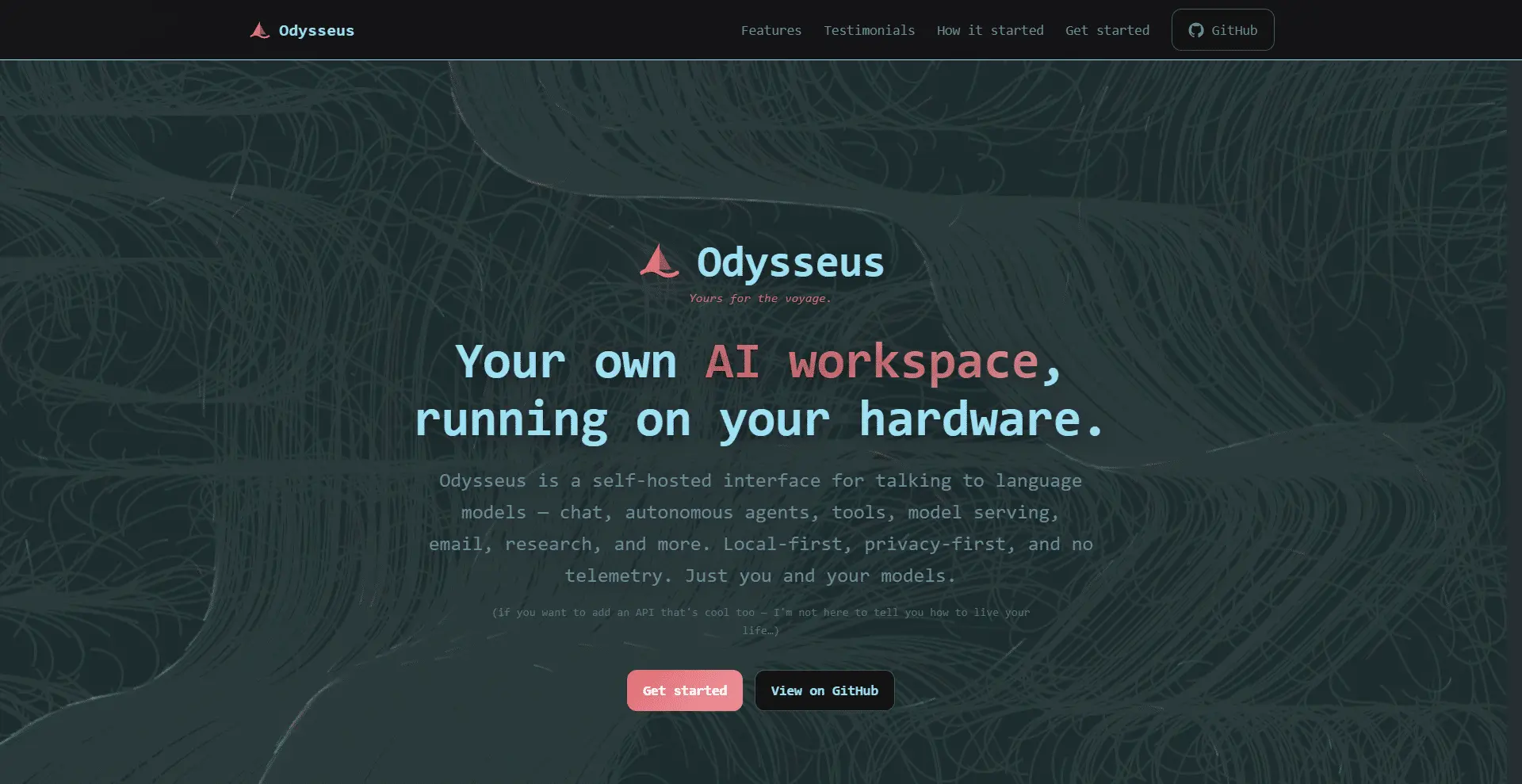
Odysseus is a free, open-source, self-hosted AI workspace. The project says it is meant to recreate the web UI experience people get from ChatGPT and Claude, but with a local-first and privacy-first approach.
In the README, the project describes itself as running on your own hardware, with your own data, and “no trojan.” The landing page calls it “A Self-Hosted AI Workspace.” The GitHub repo is licensed under MIT, which means people can inspect it, run it, modify it, and build on top of it.
As of June 4, 2026, the repo had more than 44,000 GitHub stars. That is a massive amount of attention for a project that was created on May 31, 2026. Some of that is obviously PewDiePie's name. But the reaction also says something about the moment we are in: people want AI tools, but they are increasingly uncomfortable with how much those tools depend on cloud platforms and private company servers.
Supports seamless conversation with any local model or cloud API (Ollama, OpenAI, OpenRouter, and more), with an effortlessly simple setup. The built-in Cookbook automatically scans your hardware, intelligently recommends compatible models, and downloads them in one click. A multi-model blind comparison tool is also included to eliminate selection bias.
Agent mode can invoke tools including the web, files, shell, and MCP servers to independently complete entire task workflows. The Deep Research feature executes multi-step research runs, automatically gathering, reading, and synthesizing sources into a structured visual report.
The document editor is built around a "you write, AI assists" philosophy, supporting Markdown, HTML, CSV, and more — with AI offering suggestions rather than taking over. The persistent memory system (powered by ChromaDB and vector retrieval) allows the Agent to continuously deepen its understanding of your habits and task preferences over time, growing smarter with every interaction.
Brings together email (IMAP/SMTP, with AI triage, auto-summarization, and reply drafts), notes and tasks (with scheduled reminders and cron-style automation), and a calendar (CalDAV sync with Nextcloud, Apple, Fastmail, and more) — all running locally. PWA support means it installs and runs beautifully on mobile, keeping everything accessible wherever you are.
Connect
Bring in models, files, tools, inbox, calendar, and workspace context.
Structure
Odysseus AI organizes documents, memory, tasks, and available tools into usable context.
Delegate
Run agents across research, drafting, summarization, scheduling, and local workflows.
Review
Inspect outputs, sources, actions, and next steps before anything moves forward.
Continue
Keep working with memory, follow-up tasks, and reusable workflows.
Uncompromising Privacy — Odysseus AI is built on a local-first architecture, meaning all conversations, files, memories, and workflows are stored on the user's own hardware by default. No data is ever uploaded to third-party servers, and there is zero telemetry. For professionals handling sensitive legal, medical, or financial information, this is not merely a privacy preference — it is a hard compliance requirement.
Completely Free and Open-Source — Odysseus AI is publicly available on GitHub with no monthly subscription fees. Users are free to inspect the source code, build on top of it, or contribute to the community. The project has already attracted over 23,000 GitHub Stars, with a steadily growing ecosystem.
Exceptional Model Flexibility — The platform supports both local model backends (such as Ollama, llama.cpp, and vLLM) and external API providers (such as OpenAI and OpenRouter). Users can switch between and compare outputs from multiple models within a single interface — without being locked into a single model ecosystem the way ChatGPT enforces.
A Truly All-in-One Workspace — Odysseus consolidates AI chat, autonomous agents, deep research, persistent memory (via ChromaDB), email management, task automation, document editing, and calendar into one unified interface. It effectively combines the capabilities of ChatGPT, Claude, Notion AI, and an AI agent platform, dramatically reducing the need to juggle multiple tools.
Offline Capability and Deep Customizability — When connected to local models, Odysseus runs entirely without an internet connection, making it well-suited for restricted network environments or situations where offline reliability is critical. As a fully open-source project, it also allows users to customize features and modify the codebase to any degree — a level of flexibility no cloud AI platform can match.
High Setup Barrier — Getting started with Odysseus AI requires a degree of technical know-how: users must install Docker and Docker Compose, clone the repository via Git, and be capable of handling Python environment configuration and dependency conflicts. For users without a technical background, the initial setup can be genuinely frustrating, sometimes requiring additional tools just to diagnose installation errors.
Dependent on Local Hardware — Running AI models locally places significant demands on hardware, particularly GPU VRAM and system memory. Users with modest hardware may be unable to run larger models smoothly, or may be limited to lightweight models with noticeably reduced capabilities — a meaningful gap compared to the experience offered by cloud-based large language models.
Local Models Cannot Match Top-Tier Cloud AI — While Odysseus supports external APIs like OpenAI, doing so partially undermines its core privacy advantage. Meanwhile, purely local models still lag behind frontier cloud models such as GPT-4o and Claude 3.7 in overall capability, particularly in complex reasoning and multilingual understanding.
Limited Maturity and Unproven Stability — Odysseus AI is still a relatively young open-source project. Certain features — such as local Ollama connectivity and Agent mode — have shown instability in real-world use, with users reporting dependency errors and service interruptions. Compared to commercially polished cloud products, both overall stability and documentation quality leave room for improvement.
Maintenance Relies on the Community — As an open-source project, feature development, bug fixes, and technical support depend largely on community contributions rather than a dedicated engineering team. For enterprise users or scenarios requiring a formal SLA, this community-driven maintenance model introduces a degree of uncertainty that may be difficult to accept.
Odysseus AI is designed for private deployments where your files, tools, memory, inbox, calendar, and model workflows stay under your control. For technical users, that means it can run as a self-hosted workspace on your own infrastructure.
Odysseus AI can replace parts of the ChatGPT workflow for private research, local models, agents, documents, memory, email, and calendar work. But it is designed as a private AI workspace, not just another chatbot.
Odysseus AI is built for private research, agent tasks, document work, email and calendar operations, memory, local model workflows, and MCP tool use.
Odysseus AI is designed to work with local models and compatible model endpoints, so teams can choose the model path that fits their infrastructure.